Hours, directions, entrances and the best time to arrive
San Gimignano Civic Museum visitor guide
San Gimignano Civic Museum is the civic heart of the town — a medieval town hall, small pinacoteca, fresco cycle, and tower climb in one compact visit. It is not a large, all-day museum, but it rewards slow looking more than people expect, especially in the Sala di Dante and the Camera del Podestà. The biggest difference between a rushed visit and a good one is doing the frescoed rooms before the tower. This guide covers timing, tickets, entrances, and the route that works best.
Quick overview: San Gimignano Civic Museum at a glance
This is a short visit on paper, but the rooms, tower, and Piazza del Duomo setting make timing matter more than size.
- When to visit: Monday–Sunday: 10am–7:30pm from April 1 to October 31, 11am–5:30pm from November 1 to March 31. The first hour after opening or after 5pm is noticeably calmer than 11am–3pm, because day-trippers cluster around Piazza del Duomo and the tower stairs bottleneck quickly.
- Getting in: From €10 for standard entry. The 3-day San Gimignano Pass starts at €15, and advance booking matters most in spring, summer, and early fall if you want a quieter morning slot.
- How long to allow: 1–1.5 hours for most visitors. It stretches toward 2 hours if you climb Torre Grossa, read the frescoed rooms properly, and linger in the pinacoteca.
- What most people miss: The secular frescoes in the Camera del Podestà and the older painted fragments in the Sala di Dante are easy to rush past on the way to the tower.
- Is a guide worth it? Usually not for the palace alone, because a good Audioguide covers the essentials, but it adds value if you want the civic and political context behind the frescoed rooms.
Jump to what you need
🕒 Where and when to go
🗓️ How much time do you need?
Visit lengths, suggested routes and how to plan around your time
🎟️ Which ticket is right for you?
Compare all entry options, tours and special experiences
🗺️ Getting around
How the galleries are laid out and the route that makes most sense
🖼️ What to see
Sala di Dante, Camera del Podestà, Torre Grossa
♿ Facilities and accessibility
Restrooms, lockers, accessibility details and family services
Where and when to go
How do you get to San Gimignano Civic Museum?
The museum sits on Piazza del Duomo inside San Gimignano’s walled historic center, about 1 minute from Piazza della Cisterna and an 8–10 minute walk from Porta San Giovanni.
Piazza del Duomo, 2, 53037 San Gimignano SI, Italy
→ Open in Google Maps (Google Maps: ‘Piazza del Duomo, San Gimignano’)
- Bus from Poggibonsi: Line 133 → Porta San Giovanni / Piazzale Montemaggio → 8–10 min walk → simplest public-transport link from the railway station.
- Bus from Siena: Line 130 → Porta San Giovanni → 8–10 min walk → direct and easier than changing trains.
- Car: P1 Giubileo → 8–10 min walk → cheapest official lot, with seasonal Line 2 shuttle service in April–October for €1 return.
- Taxi / rideshare: Drop at Porta San Giovanni → 8 min walk → private vehicles cannot continue into the ZTL.
Getting here from nearby cities
San Gimignano works well as a day trip, but the museum is easiest when you base yourself in Siena, Poggibonsi, or Certaldo rather than driving into the hill town.
From Siena
- Distance: 42km
- Travel time: 55–70 min via Line 130 bus
- Time to budget: Leaves enough time for the museum, the Duomo, and a relaxed lunch if you start early
From Poggibonsi
- Distance: 13km
- Travel time: 25–35 min via Line 133 bus
- Time to budget: Best choice if you are arriving by train and want the least complicated connection
From Certaldo
- Distance: 13km
- Travel time: 20–30 min via Line 128 bus
- Time to budget: Works well for a shorter half-day visit centered on the museum and the main squares
Which entrance should you use?
The palace uses one main entrance on Piazza del Duomo, beside the Collegiata, and the most common mistake is assuming the museum, tower, and ticket checks are in different buildings.
- Located on Piazza del Duomo. Expect 5–15 min wait during late morning and early afternoon in April–October.
When is San Gimignano Civic Museum open?
- April 1 – October 31: 10am–7:30pm
- November 1 – March 31: 11am–5:30pm
- December 26 – January 6: 10:30am–6:30pm
- December 25: Closed
- January 1: Some official local listings show 12:30pm–5:30pm
- Last entry: 30 min before closing
When is it busiest? Late morning to mid-afternoon, especially weekends and April–October, when tour groups fill Piazza del Duomo and the tower staircase slows down.
When should you actually go? Go right at opening or after 5pm, when the civic rooms are easier to read in peace and the tower climb feels less stop-start.
How much time do you need?
| Visit type | Route | Duration | Walking distance | What you get |
|---|---|---|---|---|
Highlights only | Entrance → Sala di Dante → Camera del Podestà → exit | 45–60 min | ~0.3km | You see the two most distinctive frescoed rooms and skip Torre Grossa, most of the pinacoteca, and the slower art-historical build-up. |
Balanced visit | Entrance → Sala di Dante → Camera del Podestà → Pinacoteca highlights → Benedetto da Maiano Crucifix → Torre Grossa → exit | 1.25–1.75 hrs | ~0.6km | This is the best first visit, because it gives you the civic rooms, a selective run through the collection, and the viewpoint without feeling rushed. |
Full exploration | Entrance → civic rooms → full pinacoteca circuit → sculptural works → Torre Grossa → return to favorite room → exit | 2–2.5 hrs | ~0.8km | You get the museum at its best, but only if you are willing to slow down and deal with tower stairs, repeated landings, and a denser amount of wall text and imagery. |
Which San Gimignano Civic Museum ticket is best for you
| Ticket type | What's included | Best for | Price range |
|---|---|---|---|
Palazzo Comunale, Pinacoteca e Torre Grossa ticket | Entry to Palazzo Comunale + pinacoteca + Torre Grossa | A focused visit where you mainly want the frescoed civic rooms and tower without adding other town monuments | From €10 |
San Gimignano Pass | Multi-site entry across the civic museum circuit + 3-day validity | A same-day or next-day visit where you also want the Duomo and other civic sites without buying separately | From €15 |
Duomo e Musei Civici | Combined entry + skip-the-line access + Audioguide | A short stay where you want the two key Piazza del Duomo sites in one purchase and do not want to queue twice | |
Palazzo ticket booked online | Palace entry + advance booking slot | A spring-to-fall visit where you want a set arrival time and would rather not decide at the desk | From €11 |
How do you get around San Gimignano Civic Museum?
The museum is compact and vertical rather than sprawling, so the challenge is not distance but sequence. It is easy to self-navigate, but it is also easy to rush straight to the tower and miss what makes the palace special.
Museum layout and suggested route
- Sala di Dante: Civic reception room with Azzo di Masetto fragments and Lippo Memmi’s Maestà → budget 15–20 min.
- Camera del Podestà: Small but memorable chamber with Memmo di Filippuccio’s secular and moral frescoes → budget 10–15 min.
- Pinacoteca rooms: Tight run of late-13th- to 15th-century Sienese and Florentine painting → budget 20–30 min.
- Sculptural highlights: Benedetto da Maiano’s Crucifix and later works → budget 10 min.
- Torre Grossa: Stair-based climb with panoramic payoff over the towers and countryside → budget 20–30 min.
Suggested route: Start with the Sala di Dante and Camera del Podestà while your attention is fresh, then move through the pinacoteca, and save Torre Grossa for the end so you do not sprint past the most unusual painted interiors.
Maps and navigation tools
- Map: On-site orientation and room labels cover the basic sequence, but a downloaded town map helps more than a museum floor plan before you arrive.
- Signage: In-venue wayfinding is good enough for the palace, but it will not tell you which rooms deserve the most time.
- Audio guide / app: Multilingual Audioguides are available, and they add real value here because the rooms make far more sense with civic and political context.
💡 Pro tip: Do not climb Torre Grossa the moment you enter — the civic rooms below are the real key to understanding the building, and you will enjoy the view more once you know what you are looking at.
Where are the masterpieces inside San Gimignano Civic Museum?

1/6
Lippo Memmi’s Maestà
Artist: Lippo Memmi, 1317
This is the museum’s signature image and the room that anchors the whole visit. It is a civic Marian fresco, not just a devotional picture, and it makes the palace feel political as much as artistic. Most visitors look only at the central figure and move on too fast; slow down for the courtly detail and the way the wall still behaves like a public statement rather than a gallery piece.
Where to find it: Sala di Dante, on the main frescoed wall.
Sala di Dante fresco fragments
Artist: Azzo di Masetto, c. 1290
These earlier secular paintings are one of the museum’s most unusual survivals, because they show tournaments and courtly scenes in a civic chamber rather than a church. They matter because they set the room’s tone before Memmi’s Maestà took over the space visually. Most people notice them only as background decoration, but they are rare evidence of a more worldly visual language.
Where to find it: Sala di Dante, around and beside the later major fresco.
Camera del Podestà frescoes
Artist: Memmo di Filippuccio, early 14th century
This small room is easy to miss, but it is one of the most distinctive spaces in the whole museum. The frescoes mix courtship, morality, and civic authority in a way that feels surprisingly intimate inside a town-hall setting. Many visitors rush through because the room is smaller and less dramatic than the tower; the reward is in the narrative detail and the rarity of the secular images.
Where to find it: Camera del Podestà within the palace rooms, after the main civic hall sequence.
Painted Cross
Artist: Coppo di Marcovaldo, c. 1255–1260
This work gives the pinacoteca real weight beyond the building itself. It is one of the clearest reminders that the collection is not just local history, but part of the broader dialogue between Sienese and Florentine painting. Many people treat it as a quick early stop, but it is one of the oldest and most important anchors in the museum.
Where to find it: Early pinacoteca rooms.
Annunciation tondi
Artist: Filippino Lippi, 1482–1484
These paired roundels are the cleanest Renaissance insertion in the palace collection and feel completely different from the heavier civic medieval rooms around them. They are worth slowing down for because they show how municipal ambition in San Gimignano reached beyond local painters. Visitors often glance at them and move on because they are smaller than the frescoes; look closely at the refinement and shift in visual language.
Where to find it: Later Quattrocento rooms in the pinacoteca.
Torre Grossa
Attribute — Tower viewpoint: Medieval civic tower
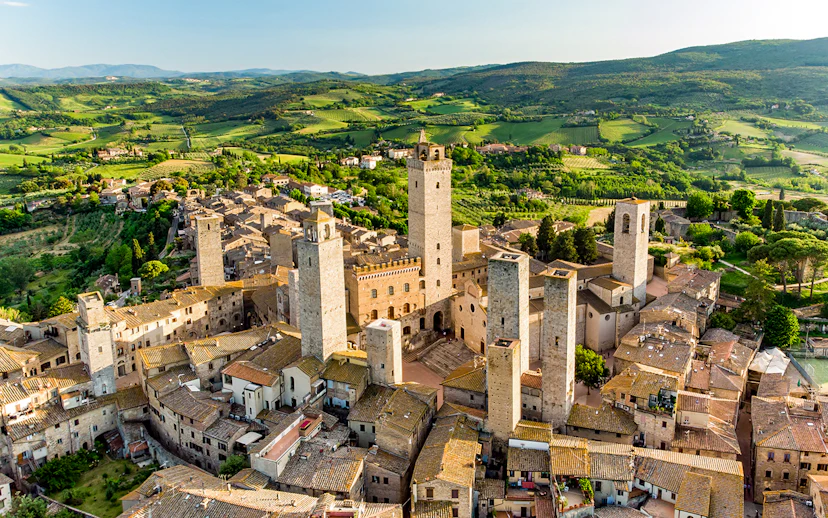
The climb is physically the hardest part of the visit, but it is also the clearest payoff if you want to read San Gimignano as a living skyline rather than a museum object. From the top, the relationship between the palace, Duomo, towers, and surrounding countryside suddenly makes sense. Most visitors rush the final platform for photos; the better move is to take a full slow circuit and identify the town’s north-south spine.
Where to find it: Accessed from within the Palazzo Comunale route.
Facilities and accessibility
- 🎒 Cloakroom / lockers: No staffed cloakroom is listed, so bring only what you can comfortably carry up narrow stone stairs.
- 🚻 Restrooms: The nearest clearly documented public museum restrooms are at the Santa Chiara complex rather than inside the palace branch itself.
- 🛍️ Gift shop / merchandise: A bookshop is listed, and it is the best place to pick up art books, catalogs, and postcards tied to the collection.
- 📖 Audioguide: Multilingual Audioguides are available, and they are more useful here than at many small museums because the civic rooms need context.
- 🧭 Interactive interpretation: Official sources mention signage, touch screens, and interactive viewing tools rather than hands-on displays.
- 🍽️ Cafe / restaurant: No café or restaurant is listed on-site, so plan coffee, lunch, or water before or after your visit in the surrounding streets.
- ♿ Mobility: Accessibility is partial rather than full, because regional records mention barrier-free provision with exceptions and Torre Grossa is stair-only.
- 👁️ Visual impairments: Official public pages do not clearly detail tactile maps, Braille tools, or dedicated visual aids, so ask at entry what support is available that day.
- 🧠 Cognitive and sensory needs: No formal quiet-hour program is publicly advertised, and the calmest practical window is the first hour after opening before Piazza del Duomo fills.
- 👨👩👧 Families and strollers: Family programming exists, but stroller-specific and baby-care facilities are not clearly listed online, and the tower route should be treated as inaccessible for strollers.
This works best for school-age children who can handle stairs and enjoy towers, views, and a few standout rooms more than a long art-heavy route.
- 🕐 Time: 45–60 min is realistic with younger children, and the best priorities are the Sala di Dante, one or two pinacoteca stops, and Torre Grossa if stairs are manageable.
- 🏠 Facilities: Family-focused educational programming exists, but practical baby-care facilities are not clearly documented for the palace branch itself.
- 💡 Engagement: Turn the visit into a tower-and-symbol hunt by asking children to spot coats of arms, saints, and the town’s skyline before you climb.
- 🎒 Logistics: Bring water and keep bags light, because there is no staffed cloakroom and the climb changes the visit from gentle museum walking to stair-heavy effort.
- 📍 After your visit: Piazza della Cisterna is 1 minute away and is the easiest reset point for gelato and a short break.
Rules and restrictions
What you need to know before you go
- Entry requirement: You need a valid palace ticket, a San Gimignano Pass, or a combined Duomo and civic museums ticket, and reduced or free admission categories should be backed up with ID.
- Bag policy: There is no staffed cloakroom listed, so a small day bag is the safest choice if you plan to climb Torre Grossa.
- Re-entry policy: Re-entry is not clearly highlighted on the main public pages, so ask at the desk before exiting if you plan to leave mid-visit.
- Dress guidance: There is no formal dress code, but closed, stable shoes are the smarter choice for worn stone steps inside the tower route.
Not allowed
- 🚫 Food and drink: Treat the museum as a no-eating space and finish open drinks before entering the frescoed rooms.
- 🚬 Smoking/vaping: Smoking and vaping are not permitted inside the historic building.
- 🖐️ Touching exhibits: Do not touch painted walls, panels, or sculptural surfaces, because many highlights remain in their original historic setting.
Photography
Photography guidance is not spelled out in full detail on the most accessible public pages, so the safest working rule is non-flash personal photography only. Treat flash, tripods, and selfie sticks as off-limits, and ask staff before photographing temporary displays or narrow tower landings where space is limited.
Good to know
- Official pages use both Piazza del Duomo 2 and Piazza del Duomo 4, but both point to the same palace frontage beside the Collegiata.
- The museum feels easy at first, but Torre Grossa changes the visit physically; if stairs are not for you, the civic rooms still justify the ticket on their own.
Practical tips
- Book the first slot you can get in April–October if the tower matters to you, because the biggest crowd change happens after about 11am when Piazza del Duomo fills with day-trippers.
- Do the Sala di Dante and Camera del Podestà before Torre Grossa, because once you have climbed the tower it is easy to mentally downgrade the rooms you rushed through to get there.
- If you are deciding between tickets, the €10 palace ticket is enough for a focused visit, but the €15 San Gimignano Pass is usually the better buy if the Duomo is also on your list.
- Bring only a light bag, because no staffed cloakroom is listed and even a normal backpack feels more annoying than usual on the narrow stone stair sections.
- Use the restroom before you start, because the nearest clearly documented museum restrooms are at the Santa Chiara complex rather than inside the palace branch.
- Do not plan lunch for 12 noon to 2pm if you want a smooth visit, because that is when town crowds and museum pressure overlap; a late lunch after 2pm feels much easier.
- If you are short on time, skip the slower middle stretch of the pinacoteca rather than the frescoed rooms, because the palace’s personality lives in the civic spaces first and the tower second.
- Pair the museum with the Duomo across the square, not with a long walk elsewhere, because this is where San Gimignano’s civic and religious imagery makes the most sense side by side.
What else is worth visiting nearby?
Commonly paired: San Gimignano Duomo
San Gimignano Duomo
Distance: 30m — 1 min walk
Why people combine them: It sits directly opposite the palace, and seeing the civic rooms and the church back-to-back gives you the clearest read of how public and religious power shared the same square.
Book / Learn more
✨ San Gimignano Civic Museum and San Gimignano Duomo are most commonly visited together — and simplest to do on a combo ticket. The pass saves you from buying two separate entries and makes the Piazza del Duomo cluster feel like one joined-up visit. → See combo options
Commonly paired: Santa Chiara museum complex
Santa Chiara museum complex
Distance: 500m — 7 min walk
Why people combine them: It extends the civic museum circuit with archaeology, the Spezieria, and temporary exhibitions, so it works well if you want more than a quick tower-and-fresco stop.
Book / Learn more
Also nearby
Piazza della Cisterna
Distance: 120m — 2 min walk
Worth knowing: This is the easiest nearby pause point for photos, people-watching, and a reset between the museum and lunch.
Rocca di Montestaffoli
Distance: 350m — 5 min walk
Worth knowing: It gives you another strong viewpoint without museum timing pressure, so it pairs well if Torre Grossa feels too cramped or stair-heavy.
Eat, shop and stay near San Gimignano Civic Museum
- On-site: No café is listed inside the museum, so treat the palace as a cultural stop and plan food in the lanes around Piazza della Cisterna instead.
- Better options nearby
- Gelateria Dondoli (2-min walk, Piazza della Cisterna): Gelato, $, and the easiest post-visit stop if you want a quick break without losing your place in the historic center.
- Cum Quibus (3-min walk, Via San Martino 17): Tuscan plates, $$–$$$, and a good fit if you want a proper lunch after the tower climb.
- RiccaPizza (4-min walk, Via Quercecchio 9): Pizza by the slice, $, and the fastest useful option if you are squeezing in the Duomo the same day.
- 💡 Pro tip: Eat before 12 noon or after 2pm, because restaurant demand peaks at the same time the museum and square are busiest.
- Museo Civico bookshop: Art books, postcards, and museum catalogs, right at the palace route, and the most reliable place for collection-related souvenirs.
Staying inside San Gimignano’s historic center makes sense if you want dawn and evening in town after the day-trippers leave. It is atmospheric and walkable, but rooms inside the walls can be pricier and involve luggage over stone streets. If you are only here for the museum and one overnight, the location works very well; for longer Tuscany touring, it is less convenient than a rail-linked base.
- Price point: The area skews toward mid-range and higher, especially inside the walls, with better value usually found just outside the center.
- Best for: Short stays where you want to walk to Piazza del Duomo early and late, when the town feels calmest.
- Consider instead: Siena or Poggibonsi if you want easier transport connections, more dining choice, and a better base for a wider Tuscany itinerary.
Frequently asked questions about visiting San Gimignano Civic Museum
Most visits take 75–105 minutes, or 45–60 minutes if you skip Torre Grossa. The tower climb, not the pinacoteca, is what usually pushes the visit longer. If you add the Duomo across the square, plan closer to 2.5 hours for the full Piazza del Duomo cluster.
No, you do not need to book far in advance year-round, but it is smart in spring, summer, and early fall if you want a specific morning slot. The museum is compact rather than massively oversubscribed, but timing still matters because late-morning arrivals overlap with the town’s busiest visitor wave.
Usually not, unless you are visiting late morning in April–October and want to combine the museum with the Duomo on a tight schedule. This is not a venue where you should expect hour-long waits most days, but a prebooked combined ticket can still save time when Piazza del Duomo is crowded.
Arrive 10–15 minutes early. That gives you enough time to orient yourself on Piazza del Duomo, confirm the entrance, and start the visit without losing time to last-minute ticket or queue confusion. It matters most if you want to climb the tower before the midday build-up.
Yes, but keep it small. No staffed cloakroom is listed, and the tower section is much easier with a light day bag than with a full backpack. If you are traveling with luggage, store it elsewhere before you arrive.
You should assume non-flash personal photography only unless staff tell you otherwise. The public pages do not clearly spell out a full photo policy, so the safest rule is no flash, no tripods, and no selfie sticks, especially in narrow rooms and on tower landings.
Yes, but smaller groups work better here than large ones. The palace rooms are compact, and Torre Grossa narrows the visit physically, so a group that can move quietly and stay together will have a far easier time than one treating it like an open square.
Yes, especially for children old enough to enjoy towers, views, and a short museum route. The strongest family hook is Torre Grossa, while the main challenge is the stair-based route. If you are visiting with younger children, keep the visit to 45–60 minutes and focus on the rooms plus the view.
It is only partially accessible. Official sources point to mixed provision with exceptions, and Torre Grossa should be treated as inaccessible because it is stair-based. The palace rooms may be manageable in part, but this is not a venue where you should assume barrier-free access end to end.
Food is available nearby, but not on-site. No café or restaurant is listed inside the palace branch, so it is better to eat in the surrounding historic center before or after your visit. Piazza della Cisterna, 1–2 minutes away, is the easiest nearby food stop.
Yes, if you are also visiting the Duomo or other civic sites, because the price jump from the palace-only ticket is small. At €15, the pass makes most sense for half-day visitors who want to stay in the Piazza del Duomo cluster and avoid buying site by site.